
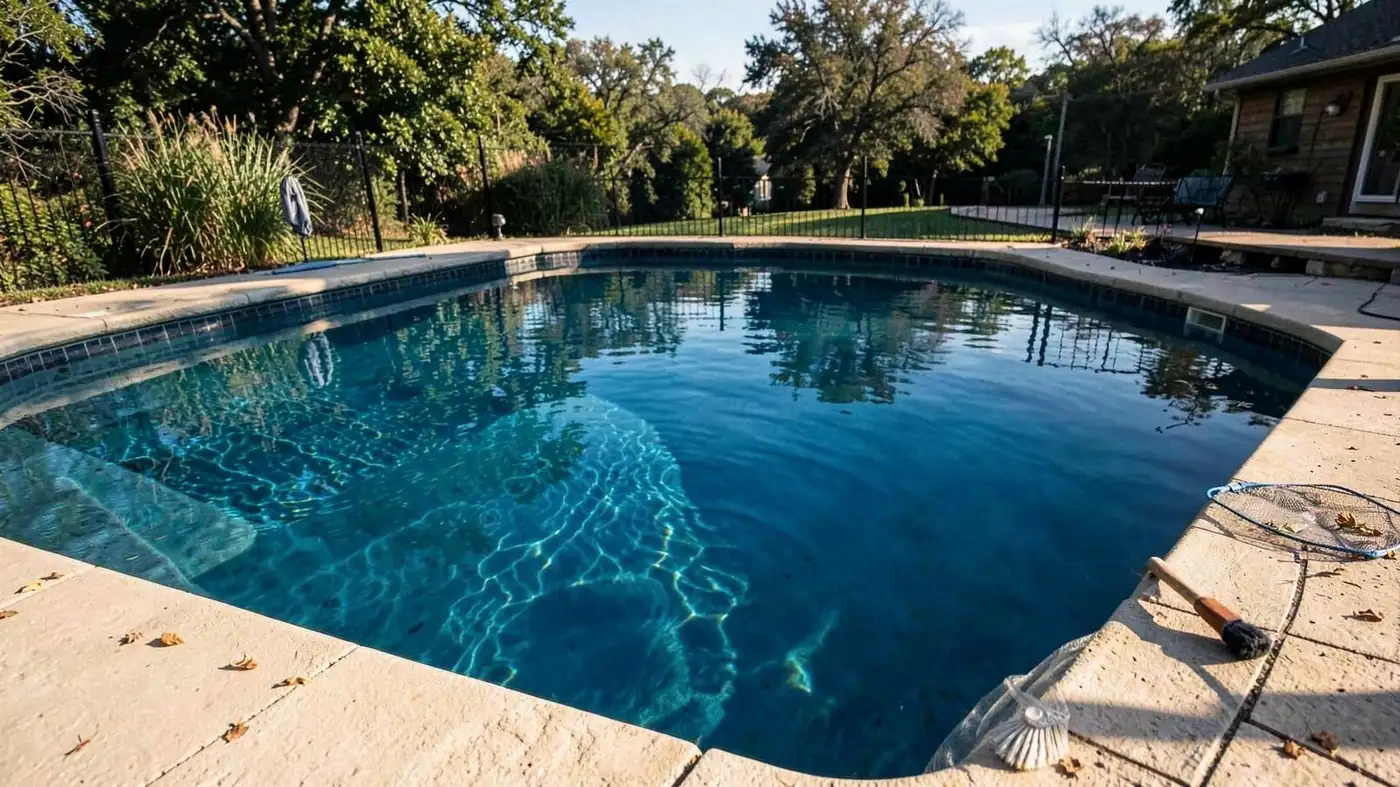
The difference you can actually see
Most pool owners get a door hanger. You get the numbers.
If the only thing your service leaves behind is a card on the gate, you have no way of knowing what your water is doing. Here's what a documented visit looks like instead.
Door hanger vs. digital report
Same hour in the backyard. Very different record of what happened in it.
None of this is a knock on the people doing the work. A route with sixty stops a day doesn't leave time to write anything down. It's simply a different job than the one being done here.
What lands in your inbox after a visit
Every visit, the same record, whether you were home or on vacation.
- Timestamped check-in and check-out
- Digital readings for all eleven levels, phosphates and metals included
- Where those readings put your LSI balance
- Every product added, with amounts
- What was brushed, netted, and emptied
- Filter pressure compared to clean
- Equipment notes and anything worth watching
- Photos from the visit
Want to see one before you commit? Ask during your consultation and you'll get a real report walked through screen by screen, with the readings explained in plain English.
Sample report
What an actual visit record looks like
This is a real visit, with the address and name removed. Nothing here is typed in later from memory — it's captured at the pool.
Readings taken at the pool
- Filter pressure
- 20 psi
- Water temp
- 84 °F
- Free chlorine
- 1.07 ppm
- Total chlorine
- 1.76 ppm
- pH
- 7.8
- Total alkalinity
- 61 ppm
- Calcium hardness
- 340 ppm
- Cyanuric acid
- 48 ppm
- Phosphates
- 175 ppb
- Copper
- 0.2 ppm
- Iron
- 0 ppm
- TDS
- 2,000 ppm
- Borates
- 0 ppm
Slightly under neutral — safe, but trending toward aggressive. That's the kind of drift worth correcting this week instead of after it reaches the plaster.
Work completed, item by item
- ✓Chemicals checked
- ✓Chemicals adjusted
- ✓Equipment pad inspected
- ✓Surface skimmed
- ✓Baskets emptied
- ✓Cleaner and bag serviced
- ✓Pool brushed
- ✓Filter pressure logged
Flags such as low water level, no power to equipment, or storm conditions that stopped pole work get recorded the same way, so you know why something was skipped.
Exactly what went in the water
- Cal hypo shock (65–68%)
- 1½ lb
- Trichlor (90%+)
- 1 lb
- Sodium bicarbonate
- 8 lb
Amounts are calculated from that day's readings and your pool's actual volume, not a standard scoop.
History you can scroll back through
| Visit | Pressure | Temp | Free Cl |
|---|---|---|---|
| 6/15 | 20 psi | 84 °F | 0.24 |
| 6/30 | 20 psi | 84 °F | 0.04 |
| 7/8 | 20 psi | 86 °F | 0.00 |
| 7/15 | 20 psi | 81 °F | 0.35 |
A run of low chlorine like this is the conversation starter — it usually means demand, stabilizer, or runtime, and the history is how you tell which one.
A note when the visit closes
Your pool is now sparkling clean
"You should be able to get back in around 1:15. Thanks for letting me take care of it today."
Plus a photo of the finished pool, and a heads-up before arrival if you have dogs out or workers in the yard.
Photo proof
At least one photo from every visit
Not a marketing promise — part of how the visit gets closed out.
You see the pool
A picture of the water after the work is done tells you more than any checkbox. Clarity, waterline, debris load — it's all right there.
You see the pad
Photos of equipment issues come with the note that describes them, so you're not trying to picture a part you've never looked at.
You have a record
When something changes months later, the photos show when it started. That's how small problems stay small.
Water Health Score
One number that tells you how your water is doing
Your readings are useful. A trend is more useful.
How it works
Each visit's readings roll into a single score built on LSI balance first, then sanitizer, then the levels that decide how hard the rest of the season will be — cyanuric acid, calcium hardness, and alkalinity. High score, easy water. Sliding score, something is drifting and it's worth a conversation now instead of in July.
Why it matters
Most water problems don't arrive suddenly. Cyanuric acid creeps, calcium climbs, and one day chlorine stops working and nobody can say when it started. A score you can watch month to month turns that slow drift into something you can see coming.
Curious what your pool would score today? Run your own numbers through the LSI calculator.
The pledge
Your plaster and equipment are the point
Clear water is the easy part. Protecting what holds the water is the job.
A pool is one of the more expensive things in your backyard, and the two ways it gets damaged quietly are unbalanced water and equipment nobody's watching. Water that runs aggressive pulls calcium out of plaster and etches the surface. Water that runs scaling leaves deposits on tile, in the heater, and across the salt cell. Neither one looks like a problem the week it starts.
So the commitment here is simple: your water gets balanced against LSI rather than eyeballed, every reading gets recorded so drift is visible, your filter gets cleaned on pressure and season rather than on a guess, and your equipment gets looked at and listened to every single week. When something is wearing out, you hear about it while it's still a part and not yet a project.
And when the work falls outside what should be handled here — anything electrical, panel-side, or specialty — you'll get pointed to a trusted company rather than a guess.
See a real report before you switch
Your consultation includes an on-site water test and a walkthrough of an actual visit report, so you know exactly what you'd be getting every week.