
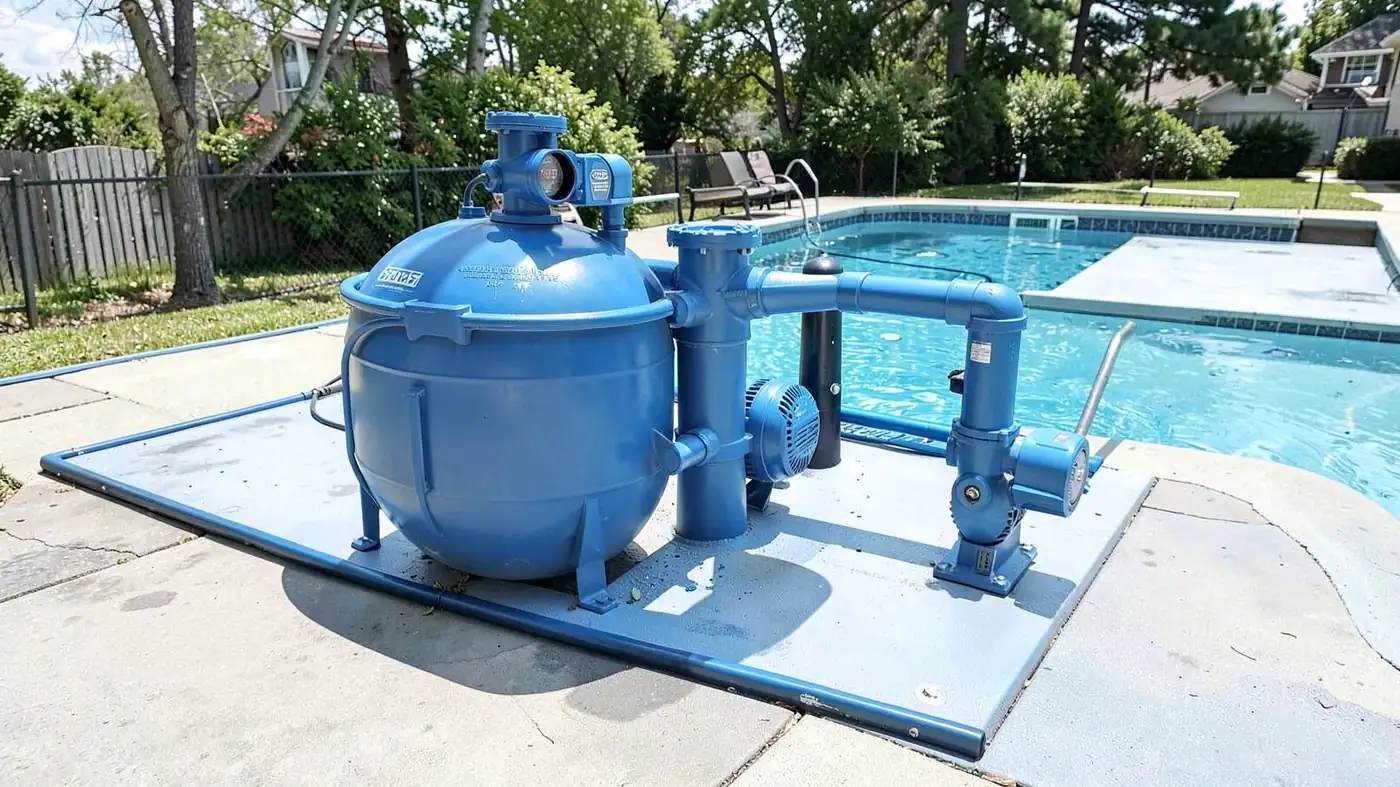
Filter service
Filter cleans that actually clean the filter.
A hose rinse takes five minutes and does about that much good. A proper filter service is a teardown, a deep clean, an inspection, and a new pressure baseline.
What a proper filter service includes
Same process for cartridge or DE, with the differences that each type demands.
- Shut down and depressurize the system safely
- Full teardown of the filter housing
- Cartridge: separate and clean through every pleat
- DE: pull, inspect, and clean each grid, then recharge
- Deep clean to remove oils, sunscreen, and mineral buildup
- Inspect grids, bands, manifolds, standpipes, and O-rings
- Lubricate and reseal correctly on reassembly
- Purge air and confirm flow
- Record a new clean-pressure baseline you can watch all season
- Salt pool? The cell comes out and gets cleaned at the same visit
Salt pools
Salt cells get cleaned quarterly too.
A scaled cell stops making chlorine long before it throws an error, and most owners find out when the water turns.
On a salt pool the cell comes out with the quarterly filter clean: pulled, acid-bathed to strip calcium off the plates, inspected for scaling, wear, and blade damage, then reinstalled with fresh unions and a flow check. Cleaning cells is my work. Installing or replacing one is wired equipment, so that goes to a licensed pro.
Cartridge vs DE
Cartridge filters
Simple, no backwash water wasted, and forgiving — right up until oils and minerals blind the pleats. A hose alone cannot pull that out, which is why neglected cartridges get replaced in two years instead of lasting five.
DE filters
The finest residential filtration available, at the cost of real maintenance. Grids tear, manifolds crack, and DE blows back into the pool — a symptom most owners misread as an algae problem.
Cadence
How often yours actually needs it
Filter type sets the baseline. Bather load, trees, pollen, and pressure move it from there.
Cartridge — quarterly, four times a year
Cartridges have no backwash to shed load, so everything the pool catches stays in the pleats until someone pulls them. Every three months keeps flow strong, keeps elements alive for years instead of seasons, and keeps your pump from working against a wall.
DE — two to three times a year
Twice a year is the floor. Heavy bather load, live oaks, cedar pollen season, or a pressure baseline that keeps climbing pushes it to three. Backwashing between cleans helps, but it never removes the oils and mineral load that blind the grids.
Put it on a plan and it just happens — no calls, no remembering, no August surprise. What moves your number: how many people swim, how close the trees are, cedar and oak pollen in spring, salt systems, heavy sunscreen use, and what your clean-pressure baseline is doing month over month.
When your filter is telling you it's time
Independent of the schedule, these are the signs that it needs opening now.
- Pressure has climbed roughly 8–10 psi above the clean baseline.
- Return jets are weak or the water surface has stopped moving.
- The pool stops holding clarity even though chemistry reads fine.
- The cleaner or skimmers have slowed down.
- DE is showing up on the pool floor after a backwash.
- It has simply been a year since it was last opened.
Pricing depends on filter type, size, and condition, and is confirmed before any work starts. If we open it up and find a torn grid, a cracked manifold, or a failed band, we can usually replace it — filter and element replacement is work we do ourselves. Anything electrical goes to a licensed pro.
Filter due for service?
Tell us your filter type if you know it, and we'll take it from there.